
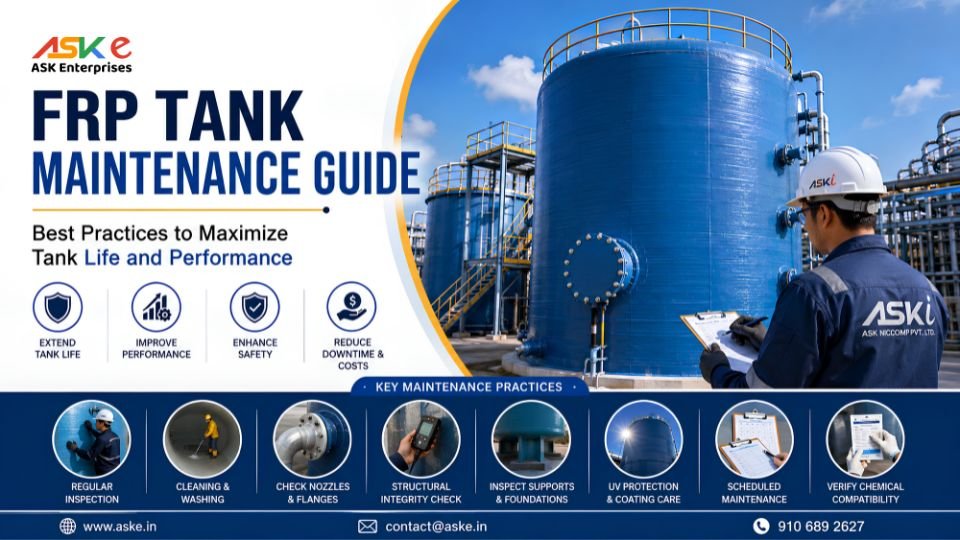
Best Practices to Maximize Tank Life and Performance
Fiberglass Reinforced Plastic (FRP) tanks are widely used across industries for storing and processing chemicals, water, acids, alkalis, and other corrosive substances. Their excellent corrosion resistance, lightweight construction, and long service life make them a preferred choice over traditional steel or concrete tanks.
However, even the most durable FRP tanks require routine maintenance to ensure optimal performance, safety, and longevity. Neglecting regular inspections or cleaning can lead to surface damage, reduced efficiency, or unexpected downtime.
This comprehensive guide explains how to maintain FRP tanks effectively, covering inspection schedules, cleaning methods, common issues, repair practices, and preventive maintenance tips.
What Is FRP Tank Maintenance?
FRP tank maintenance involves regularly inspecting, cleaning, testing, and repairing the tank to maintain its structural integrity, corrosion resistance, and operational efficiency.
Proper maintenance helps:
- Prevent leaks and failures
- Extend service life
- Improve operational safety
- Reduce repair costs
- Maintain compliance with industry standards
Why Is Regular Maintenance Important?
Routine maintenance provides several advantages:
- Extends tank lifespan beyond 20–30 years
- Prevents unexpected downtime
- Detects minor defects before they become major issues
- Protects stored chemicals from contamination
- Reduces long-term maintenance costs
- Ensures safe operation in corrosive environments
Recommended Inspection Schedule
| Frequency | Activities |
| Daily | Visual inspection for leaks, spills, and unusual conditions |
| Weekly | Check fittings, supports, valves, and external surfaces |
| Monthly | Inspect coating, joints, accessories, and structural components |
| Quarterly | Check wall thickness (if applicable), signs of chemical attack |
| Annually | Comprehensive inspection, cleaning, testing, and repairs |
Daily Maintenance Checklist
Perform a quick visual inspection:
- Check for chemical leaks
- Look for discoloration
- Ensure valves operate properly
- Verify no unusual vibrations
- Inspect connected pipelines
- Monitor liquid levels
- Confirm supports remain stable
Daily checks can identify small issues before they escalate.
Weekly Maintenance Checklist
Inspect:
- Flanges
- Nozzles
- Pipe connections
- Support structures
- Ladder assemblies
- Access platforms
- Bolts and fasteners
Also, remove dirt, dust, or chemical residues from external surfaces.
Monthly Maintenance Checklist
Conduct a more detailed inspection:
Exterior Surface
Look for:
- Cracks
- Blisters
- Delamination
- Surface erosion
- UV damage
Interior Surface
Inspect for:
- Resin wear
- Chemical attack
- Fiber exposure
- Deposits
- Scaling
Accessories
Check:
- Gaskets
- Vent systems
- Level indicators
- Overflow systems
- Safety devices
Annual Inspection Guidelines
A thorough annual inspection should include:
- Complete internal cleaning
- Structural inspection
- Thickness measurement (where required)
- Joint inspection
- Laminate condition assessment
- Support inspection
- Load evaluation
- Leak testing
If damage is detected, repairs should be carried out by qualified FRP technicians.
How to Clean an FRP Tank
Cleaning methods depend on the stored media, but general steps include:
- Drain the tank safely.
- Flush with water or a compatible cleaning solution.
- Remove deposits using soft brushes or non-abrasive tools.
- Avoid metal scrapers that can damage the FRP surface.
- Rinse thoroughly.
- Allow the tank to dry before reuse.
Avoid:
- Steel brushes
- High-impact tools
- Strong solvents that are incompatible with the resin system
Common Problems and Solutions
| Problem | Possible Cause | Recommended Action |
| Surface cracks | Mechanical impact or stress | Inspect and repair laminate |
| Blisters | Chemical permeation | Evaluate resin compatibility and repair |
| Discoloration | UV exposure or chemical attack | Clean and apply protective coating if needed |
| Leaks | Damaged joints or fittings | Replace gaskets or repair affected area |
| Delamination | Age, impact, or manufacturing defects | Professional FRP repair |
Preventive Maintenance Best Practices
- Use chemicals compatible with the tank's resin system.
- Avoid exceeding the tank's design temperature and pressure.
- Prevent overfilling by using level sensors or alarms.
- Protect outdoor tanks from prolonged UV exposure with suitable coatings.
- Maintain proper support and foundation to prevent stress.
- Keep accurate maintenance records for inspections and repairs.
Safety Precautions
When maintaining an FRP tank:
- Wear appropriate PPE (gloves, goggles, protective clothing).
- Follow confined space entry procedures for internal inspections.
- Ensure the tank is fully drained and ventilated before entry.
- Isolate connected pipelines and equipment.
- Handle cleaning chemicals according to safety guidelines.
- Use fall protection when working at height.
When Should an FRP Tank Be Repaired?
Schedule repairs if you notice:
- Persistent leaks
- Deep cracks
- Delamination
- Significant resin erosion
- Exposed fiberglass
- Structural deformation
- Damage after impact
Timely repairs can prevent costly replacements and minimize downtime.
Tips to Extend FRP Tank Life
- Follow a preventive maintenance schedule.
- Clean the tank regularly.
- Inspect accessories and fittings.
- Use compatible chemicals.
- Avoid mechanical impacts.
- Protect against excessive UV exposure.
- Train operators on proper handling and maintenance.
- Keep detailed inspection and maintenance logs.
With proper care, many FRP tanks can deliver reliable performance for decades.
Frequently Asked Questions (FAQs)
1. How often should an FRP tank be inspected?
A visual inspection should be performed daily, with detailed inspections monthly and a comprehensive assessment annually.
2. Can FRP tanks be repaired?
Yes. Minor cracks, leaks, and laminate damage can often be repaired by experienced FRP specialists.
3. What is the typical lifespan of an FRP tank?
Depending on design, operating conditions, and maintenance, FRP tanks can last 20–30 years or more.
4. Are FRP tanks resistant to all chemicals?
No. Resin selection must match the chemical being stored. Always verify chemical compatibility before use.
5. Can pressure washers be used for cleaning?
Low-pressure washing may be suitable, but excessive pressure or abrasive methods should be avoided to prevent surface damage.
6. What causes blistering on FRP tanks?
Blistering can result from chemical permeation, improper resin selection, or prolonged exposure to harsh operating conditions.
7. Why is UV protection important?
Extended UV exposure can degrade the resin surface over time. UV-resistant coatings help protect outdoor installations.
8. Should maintenance records be kept?
Yes. Detailed records of inspections, cleaning, and repairs support preventive maintenance and regulatory compliance.
Conclusion
Regular maintenance is essential to maximize the performance, safety, and lifespan of FRP tanks. By implementing scheduled inspections, proper cleaning procedures, preventive maintenance, and timely repairs, industries can reduce downtime, lower operating costs, and ensure reliable chemical storage and processing.
Whether your FRP tanks are used in chemical manufacturing, water treatment, electroplating, or other industrial applications, a proactive maintenance program protects your investment and supports long-term operational efficiency.
Need durable, low-maintenance FRP tanks for your industrial application?
Contact ASK Enterprises to discuss your storage and process tank requirements. Our team can help you choose the right tank design, materials, and maintenance approach for long-term reliability.
